
Study tips #1: Organisation is key
Our distance learning students agreed that being organised and planning ahead put them at an advantage. Both Daniel, who studied Management & Leadership in health & Social Care, and Sophie, who studied Applied and Clinical Psychology, agreed that being proactive was important.
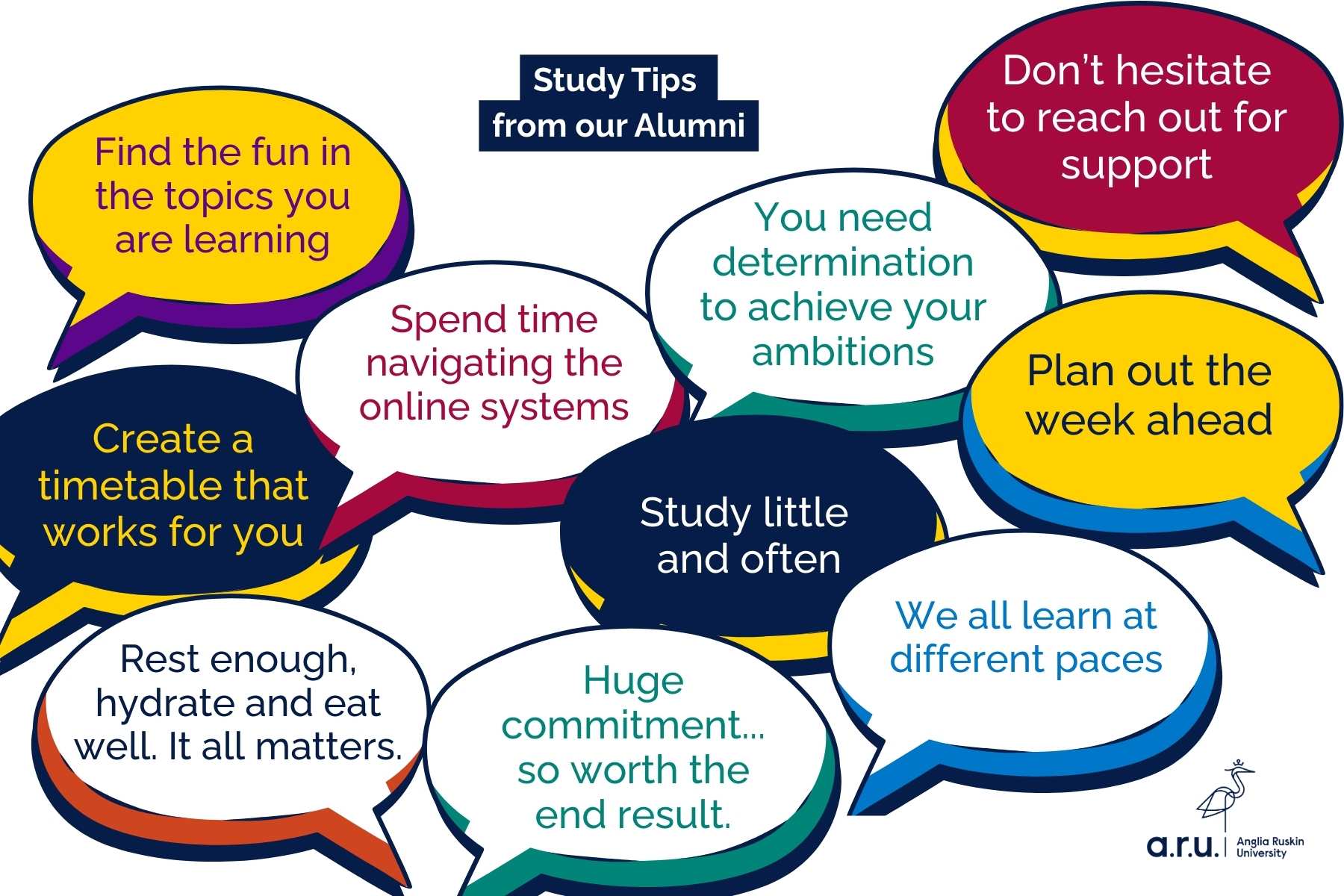
“I planned out the week ahead with what was realistic and broke the work up into manageable chunks.” Daniel
“Be super organised and try and get ahead of the game where you can. As soon as you are made aware of an assignment, set a schedule of when you are going to be able to invest time to complete it. Do not wait until the day before to start the essay or task.” Sophie
Study tips #2: Create a study schedule
Creating a study schedule or study timetable was a piece of advice that came up repeatedly amongst our former students.
For Dean (who studied Management & Leadership in health & Social Care), it was about being disciplined and maintaining work life balance and putting in place a schedule enabled him to do that.
“I needed to be disciplined with what free-time I had to ensure that I gave my study the level of attention required, whilst also maintaining a healthy work life balance. I achieved this by creating a timetable, providing protected time for study, but also factoring in downtime. This allowed me to ensure that I completed academic study little and often, keeping my mind fresh, whilst ensuring that I kept a healthy mind-set.” Dean.
For Cat, who studied Healthcare Management MSc (Armed Forces), it meant a pragmatic approach – “Understanding what time of day is best to learn is also important as it helps you schedule your time so that you get the best out of your study time.”
Study tips #3: Everybody’s timetable looks different
If study tip number 2 tells us that creating a timetable is important, then study tip number 3 tells us that because our lives are different our timetables should reflect that.
Shipa, who studied Applied Linguistics & TESOL MA, explains, “Create a realistic timetable that works for you and the demands of your course.”
Dean goes further, making the point that not only are our lifestyles different, but we, as individuals, are different _ “Remember, everyone’s commitments are different, and some people may seem to be way ahead of you. We all learn at different paces.”
Study tips #4: Does the curriculum excite you?
Studying for a degree is hard work that requires your time, financial and emotional resources. Therefore, before you commit, be sure that the course is right for you. This doesn’t just mean ‘does it fit your end goal’ – although that is important – but does it excite you? As Sophie explains:
“Be certain about the subject you want to take. Read through the module titles, if they do not excite you and make you want to start ASAP then reconsider if this is the course for you. You need to be passionate and interested! Studying can be stressful, so you need to find the fun in the topics you are learning.”
Study tips #5: Ask for help
Simply asking for help is another study tip that our distance learning alumni recommended. It sounds simple, but asking is a powerful tool, and one that will save you lots of time according to TESOL former-student, Shipa _ “[don’t] feel embarrassed to contact the relevant staff or team when you require support. This will save you a lot of time.”
Sophie agrees, finding support from friends and family is crucial. She says, “Having a good support network around you (family/ friends) who you can call upon for help when you need it. My husband is a tremendous support to me and without his continuous encouragement I don’t know if I would be able to get through it.”
Mario studied the Project Management MSc. He advises, “Don’t hesitate to reach out for support when needed. The teaching staff and support services are there to help you succeed, whether you need academic guidance or personal support.”
Study tips #6: Understand the commitment
Some of our alumni recommended taking a moment to understand the commitment you’ll be making when embarking on an online degree. Doing this helped them to consider the time and hard work they needed to dedicate, as well as the practical options of fitting it into their lifestyle. Here are three perspectives:
“Consider online study if you don’t have the capacity to access courses on campus. It can seem a bit intimidating doing a whole master’s degree online, but it really is a feasible way to study if you have work commitments and childcare responsibilities. I think it is important to take this into consideration when you are thinking about doing a degree, it is possible, but you must be prepared to do a lot of work.” Beth, Child and Adolescent Mental Wellbeing MSc
“Think about your commitments and find balance, it’s important not to over commit so you can focus on your studies.” Cat, Healthcare Management MSc (Armed Forces)
“It is a huge commitment and a challenging time, but it is so worth the end result.” Dean, Management and Leadership in Health and Social Care (top-up) BSc (Hons)
Study tips #7: Utilise the online resources
Michael, who completed his Master of Business Administration (MBA) with ARU as a distance learning student, explains how spending some time to familiarise yourself with the online recourses can be very helpful.
“It’s crucial to spend time navigating the online learning systems – click and press – you will not break the system. It’s surprising how quickly the learning management system becomes second nature. Then spend 15-20 mins a day for one week just clicking anywhere to explore.”
He also recommends ARU students do the following (although other distance learning students will find similar opportunities with their online degree provider):
- Add critical deadlines to your calendar and set up reminders
- Download the ARU and Canvas student apps to your phone/tablet
- Watch the pre-recorded video tutorials for hidden tips and tricks
- Check out Study Skills Plus – tools and resources to help students hone their study skills, e.g. referencing and citing, academic writing
- Take advantage of the one-to-one with a librarian
Study tips #8: The value of downtime
Making sure to take care of yourself both physically and mentally was another theme, our alumni spoke about. Simple acts like carving out family time, going for walks, having days off. Here’s what they suggested:
“You’ll need to be kind to yourself and allow some down time to recuperate from the accumulated stress as you may juggle work and studies. If stuck, go out for a walk in the park for half an hour to “empty your head” and get some fresh air. Rest enough, hydrate and eat well. It all matters.” Dio, Medical and Healthcare Education PG Cert
“Make sure you block at least one day a week in your diary to just be ‘you’. I found what worked for me was to work on my studies on an evening and then one day on the weekend. I made sure that I had at least one weekend day off so I could do the things I enjoyed.” Beth, Child and Adolescent Mental Wellbeing MSc
“Despite the hectic schedule, I consciously incorporated short breaks and self-care activities to avoid burnout. This included quick walks, holiday escapes and spending quality time with my family.” Mario, Project Management MSc
Study tips #9: The big motivator
What motivated you to start studying? What’s the big picture goal? Keep this in mind whilst you’re studying. For William, who completed an MBA with ARU via distance learning, it was to help him progress in his career and become a valued and respected member of the team.
See William’s video here.
Study tips #10: Believe you can do it
Studying an undergraduate or postgraduate degree whether it’s online or in the classroom takes years of hard work and determination. That’s why it’s important to believe in yourself – believe you can do it. It helps to have people rooting for you too, like friends, family and your employer. Knowing that they want you to achieve can help spur you on.
“You need determination to start your course of choice and commitment to reach the end of your journey with success. You need people around who believe in you, support you and if relevant, an employer that will allow you to pursue your ambitions.” Dio, Medical and Healthcare Education PG Cert