
What are study goals for online learning?
Study goals for online learning are all about setting your academic goals that contribute to your overall success of achieving your qualification. You can categorise them into short-term, medium-term and long-term goals or targets. For example:
- Short-term: read three chapters by Tuesday.
- Medium-term: understand XYZ topic to get at least a 2:1 grade for this module.
- Long-term: achieve a first-class degree.
You can also think of academic goals more holistically. For example, write better essays or learn how to take better notes or produce an effective study schedule.
What are study goals for online learning?
How to set study goals: 4 frameworks with examples
1. SMART targets for study goals
Specific – be specific about what you want to achieve, not vague.
Measurable – what’s the measure of success? How do you know when you’ve achieved it?
Achievable – is it achievable? How will you achieve it?
Relevant – make sure it’s directly relevant to your long-term goal.
Time-bound – say when you want to achieve the goal by.
Here’s an example:
Ace the XYZ module with a first-class grade (specific and measurable). I’ll be able to achieve this by putting together a robust study plan and getting lots of practice in via practice papers (achievable). It relates to my overall goal to get a first-class honours degree that will look great on my CV and help my career aspirations (relevant). I’ll make sure I meet the assignment deadline of X date and stay on track of all my modules (time-bound).
2. WOOP for study goals
Stands for Wish, Outcome, Obstacle and Plan. The WOOP goal setting methodology balances the positive aspects of goal outcomes with the realistic acknowledgement of potential obstacles.
Wish – what’s the goal? Should hit the sweet spot of ambitious and achievable.
Outcome – where you imagine what the outcome is both externally (what you get) and internally (how you feel).
Obstacle – reflect on the obstacles that can get in your way. This isn’t just the external obstacles like time management, lack of resources etc. but also the internal forces such as fear of failure, procrastination etc. Be honest with yourself.
Plan – with your list of obstacles, you can make a plan to achieve your goal. This will take into consideration the tactic to get there as well as counter the obstacles you’ve already considered.
Here’s an example:
I want to apply my learning from XYZ study module to my job role (wish). I see positive outcomes for both me and the company. I’ll gain a better reputation as an expert on this topic, and my department will see improved results (outcome). I want to suggest trying ABC project to trial it, but I’m worried my manager will say no and I’m already very busy at work (obstacles). I’ll write out a proposal and schedule a meeting with my manager to make my case. If he/she agrees, we can look at my work schedule to accommodate trialling the project (plan).
3. PACT method for study goals
PACT stands for Purposeful, Actionable, Continuous and Trackable. They differ from SMART and WOOP goals in that they don’t focus on the big outcome. Instead, PACT goals look at the small targets you can do to form powerful habits that contribute to the big picture goal.
Purposeful – relates to your overall big goal.
Actionable – what action are you going to take that can be repeated?
Continuous – the frequency or cadence of the action.
Trackable – a simple way to record and track your progress.
Here’s an example of a PACT goal that relates to online studies:
My goal is to read all the books on the reading list my lecturer has suggested (purpose). I’ll do this by reading two chapters (action) every morning before work (continuous) and record my progress on a simple spreadsheet (trackable).
4. Pyramid method for study goals
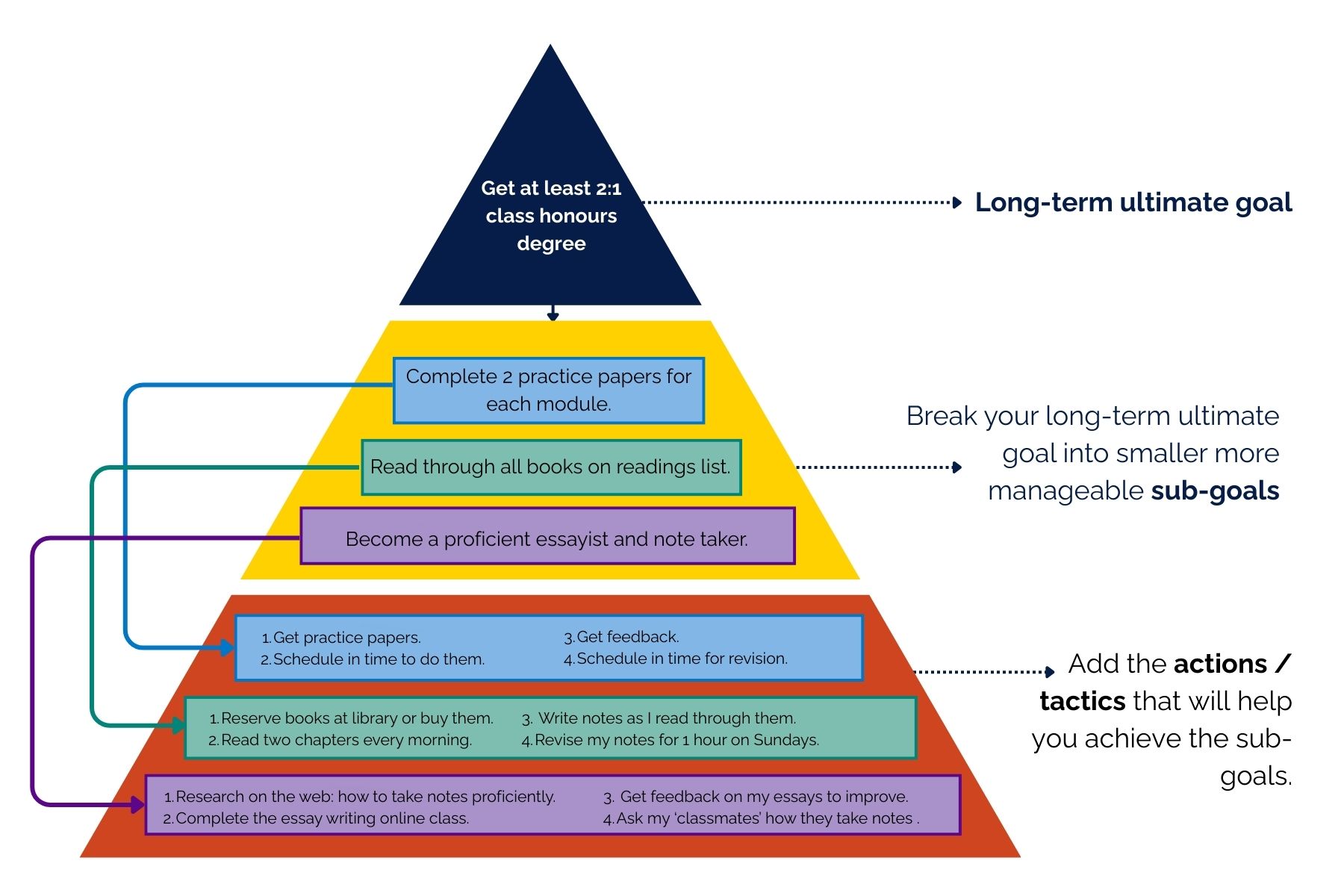
This method is adaptive enough to be used for individuals, teams or organisations. It’s great for aligning your long-term goal with medium and short-term goals and tactics. For those who prefer visuals it can provide a graphic representation of how to chunk up a big picture goal into smaller more manageable parts.
At the apex of the pyramid you place your long-term goal, e.g., pass my degree with at least a 2:1. The second tier you place your sub-goals that will help you get to the final goal. On the third tier (and underneath the relevant sub-goal), you place the action/s and milestone/s that will help you achieve each sub-goal.
You can adapt the pyramid to suit you with more tiers if that’s useful for you. You can also use the other methods such as SMART and PACT within the pyramid. Here’s an example visually represented:
How to achieve your academic study goals and stay motivated
Time management to achieve your study goals
Our distance learning students often choose online learning because of it’s flexibility, meaning they can juggle work and family with study. That doesn’t mean time management isn’t important. In fact, it’s essential to achieve a work-life-study balance. Manage your study time by:
- Planning and writing out a study schedule that incorporates your actions, milestones and sub-goals. Make sure it includes major academic deadlines.
- Blocking out time in your daily activities and sticking to the plan. Make sure your family know about this plan and commit to not distracting you during study time.
- Reviewing your study schedule regularly to make sure it’s working.
Get more time management tips here.
Get peer support to help you achieve your study goals
Online learning doesn’t mean doing it by yourself with no support. In fact, at ARU distance learning, we pride ourselves on the support we provide our online learners. You can also get support from your peers via online forums. You’ll find these online forums can be a great way to start conversations, exchange ideas, explore different perspectives and make friends.
Find out more about support for online learners here.
Take care of your mental health when working towards your study goals
Take care of your mental health and avoid burnout whilst you study towards an online degree.
- Schedule in down time, whether that’s taking the dog for a walk, hitting the gym or sitting down to meals with the family.
- Be organised and stick to the study plan. That way you know you’ve planned it all out and don’t have to think about it until the allotted time.
- Celebrate your milestones with a reward and recognise your hard work.
Resources to manage your study goals
There are a lot of digital apps and resources out there that can help you plan and manage your study goals. Here are a few to consider:
- Gantt charts are a great visual aid to see your milestone and actions across a timeline. MS Excel has several templates, or you can create your own.
- MS To-do is a handy way to manage medium-term goals with actions and timescales on one platform. Because it’s connected to Outlook, you can add schedule reminders and notifications.
- Trello is a project management tool, but you can use it to manage your study goals. There are various pricing models including a free version.
- MyStudyLife is a mobile app that helps you organise your study goals through digital features that manage scheduling, task lists and reminders.
How our distance learners achieved their online learning study goals
“Set realistic timescales, give yourself enough time for things you enjoy, allocate family time but also ensure that you protect study time little and often. Remember, everyone’s commitments are different, and some people may seem to be way ahead of you. We all learn at different paces. Also, to reach out for support if needed.”
Management and Leadership in Health and Social Care (top-up) BSc (Hons)
“Create a realistic timetable that works for you and the demands of your course. Also, not to feel embarrassed to contact the relevant staff or team when you require support. This will save you a lot of time.”
Applied Linguistics and TESOL MA
“You’ll need to be kind to yourself and allow some down time to recuperate from the accumulated stress as you may juggle work and studies. If stuck, go out for a walk in the park for half an hour to “empty your head” and get some fresh air. Rest enough, hydrate and eat well. It all matters.”
Medical and Healthcare Education PG Cert
“Ensure you take regular breaks during your studies. Make sure you block at least one day a week in your diary to just be ‘you’. I found what worked for me was to work on my studies on an evening and then one day on the weekend. I made sure that I had at least one weekend day off so I could do the things I enjoyed.”