
What is a professional development plan?
Why is a professional development plan important?
How can a professional development plan boost your career?
- Encourages career growth by identifying areas of improvement and providing clear steps to get there.
- Develops a focused strategy meaning you're more likely to succeed because you’ve thought through your goals and the ways to make it happen.
- Gives you a clear plan with resources and timeline means you’re more likely to stick to it.
- Demonstrates commitment to your current and future employers to improve your skills.
What should a professional development plan include?
Professional development plans (PDP) should be tailored to reflect your professional needs and the sector you work in. Having said that, your professional development plan should contain at least these elements:
- Career goals: what you want to achieve to boost your career and professional standing.
- Skills assessment: looking at your skills, strengths, areas that require developing.
- Learning objectives: what skills and/or qualifications do you need to gain to help you towards your career goals?
Discover our portfolio of online undergraduate and postgraduate degrees here.
- Actions: what you need to do – step-by-step – to achieve it.
- Timelines: putting timelines to your actions / goals.
- Review points: reviewing your progress and outcomes.
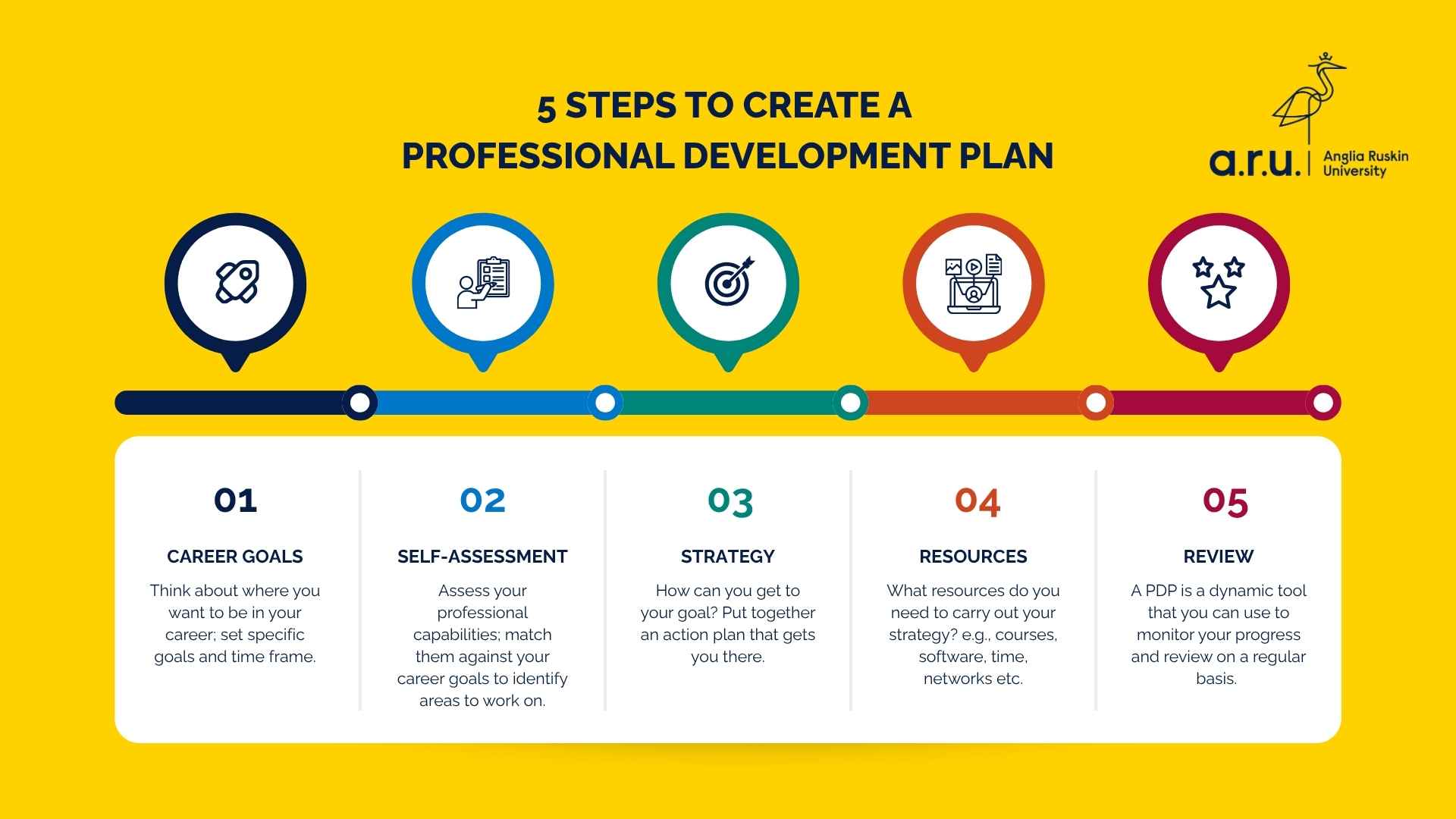
How do you create a professional development plan?
1. Set your career goals
Think about where you want to be in your career and give it a specific time frame. Career goals vary so you should set career goals that work for you.
Here are some examples:
Profession switcher: e.g., become a clinical psychologist over the next 3-5 years.
Ambitious career climber: e.g., get promoted from team leader to junior manager within 12 months.
Skills focused: e.g., learn data analytics within next 18 months.
Personal professional: e.g., settle into new job within next 4 months.
Aligned with business objectives: e.g., Increase organic traffic to website blogs by 15%.
The examples above are just a few. What’s important is choosing goals aligned to your professional ambitions and compliment your workplace values.
With ‘big career goals’ you could also break them down into smaller, short-term goals. Changing your career is an obvious example as retraining, getting new qualifications, trying to get your first break into a new industry, all require smaller short-term goals to get you there.
2. Self-assessment
This step is about looking at professional capabilities and matching them against your career goals to identify areas to work on.
Focus on these aspects:
- technical skills
- strengths
- weaknesses
- your current job responsibilities
- work-related experience
- transferable skills
- relevant qualifications
- interpersonal skills
You should also consider your current circumstances, e.g.:
- Are you currently employed?
- Do you need time to upskill / retrain / get accredited qualification?
- Do you have a way to fund a new course?
- Have you got other commitments such as caring for a young family or elderly parents?
It’s important to take your time with this and be honest when you assess yourself as it gives you a baseline to work with when it comes to putting together a strategy.
3. Strategy & action plan
Put together a strategy that gets you to your desired career goal and considers what you answered during the self-assessment stage.
Taking the profession switcher as an example:
Career goal: change career to become a clinical psychologist.
Self-assessment: they are working and raising a family and they cannot afford to give up their job to study. After some research they found out the route to becoming a clinical psychologist has many steps but one of the first is to gain a relevant undergraduate degree or postgraduate conversion degree that is BPS accredited.
Strategy: complete a BPS accredited psychology degree (the learning outcome) via distance learning that will give the flexibility to study whilst working, as a first step.
From the strategy, you can devise an action plan. In this example it could be:
- Research universities
- Attend virtual information evenings
- Research funding options
- Apply and enrol
- Set up study plan alongside work and family commitments
4. Resources
Having identified your career goal, conducted a self-assessment, and developed a strategy, you’re now a place where you can look at how to resource that strategy.
Things to consider and ask yourself (depending on your career goal):
- Which course or qualification?
- Which training provider or university?
- If studying, map out time schedule needed.
- Secure funding – self-fund, get employer sponsorship or look at student loan options.
- Are there any networks that you can join?
- Would it be helpful to have a mentor?
- Do you need to invest in any digital tools or books?
Needless to say, the resources you need should match your strategy and goals.
5. Monitor and review
A personal development plan (PDP) isn’t a static document that you write out once and stick in a drawer. It’s a dynamic tool that you can use to monitor your progress against and review on a regular basis.
Ask yourself these questions:
- Which steps have I completed? Where am I now?
- Am I meeting the timelines I’ve set, or do I need to adjust and be more realistic?
- Are the resources I gathered from the outset still working for me or do I need to revisit that?
If you’re about to achieve the goal/s you originally set out to achieve, use the professional development plan to move to the next level – going through the PDP steps again.
Professional development plan examples
Example 1: Healthcare Manager
Goal: Looking to move into healthcare management role within next 2 years.
Self-assessment: More than 5 years’ experience which have included informal leadership responsibilities when heading up projects and deputising. Strong transferable skills in communication, stakeholder management and project co-ordination. Have home commitments and need to continue working so any PDP strategies need to fit with family and work.
Strategy: Upskill and increased chances of promotion by 1. Studying a management course with healthcare focus, 2. Join network of aspiring managers in healthcare sector 3. Ask for mentorship.
Resources: 1. Online postgraduate degree in healthcare management for flexible study around work and home life. 2. Employer sponsorship 3. LinkedIn for online forums and networking groups.
Review: progress against degree, evaluation of mentorship relationship, evaluation of online forums / groups.
Discover all ARU Healthcare online degrees here.
Example 2: Education
Goal: Current teacher looking to specialise in SEND.
Self-assessment: 3 years teaching experience in mainstream primary school, any training or studying needs to fit in with work schedule.
Strategies and action plan: upskill through formal qualification delivered through distance learning, arrange work shadowing current SEND specialist (who is due to retire) one afternoon per week.
Resources: Online MA in Special Educational Needs and Disability (SEND), funding through employer sponsorship.
Review: progress against degree, evaluation of work shadowing arrangements, impact on SEND students.
Discover all ARU online Education degrees here.
Frequently Asked Questions
How often should I review my development plan?
What are examples of professional development goals?
Examples of professional development goals around skills:
- Improve communication skills
- Understand how to use Ai at work
- Learn data analytics
Examples of professional development goals around leadership:
- Study an MBA
- Lead on project
- Expand professional network
Examples of professional development goals around career advancement:
- Change career to become a…
- Get promoted to a … position
- Get a salary increase